Supplier API integration: a practical guide to automated data sync
When a supplier offers an API, you no longer have to wait for a price list in your inbox. Prices and stock can be requested directly from the supplier's system as often as you need. The catch is that every supplier API is different, and connecting them one by one to your store quickly becomes a project of its own.
File or API: which one to use
A price list file (Excel, CSV, XML) is simple and almost every supplier can provide one. Its weak point is freshness: the data is only as current as the moment the file was generated. An API gives you current values on request, which matters for fast-moving stock. In practice most stores work with both: an API for the key suppliers and files for everyone else.
Before you connect
Ask the supplier for the following and keep it in one place:
- API documentation and the base URL of the service.
- Credentials: an API key, a token or a login and password.
- Which endpoints return products, prices and stock, and whether they are paginated.
- Rate limits: how many requests per minute or per day are allowed.
- How products are identified: SKU, barcode or the supplier's internal ID.
The identifier question matters most. If the supplier's IDs do not match the SKUs in your store, you need a reliable way to link them, otherwise updates land on the wrong products.
Connecting a supplier API in YfiFX
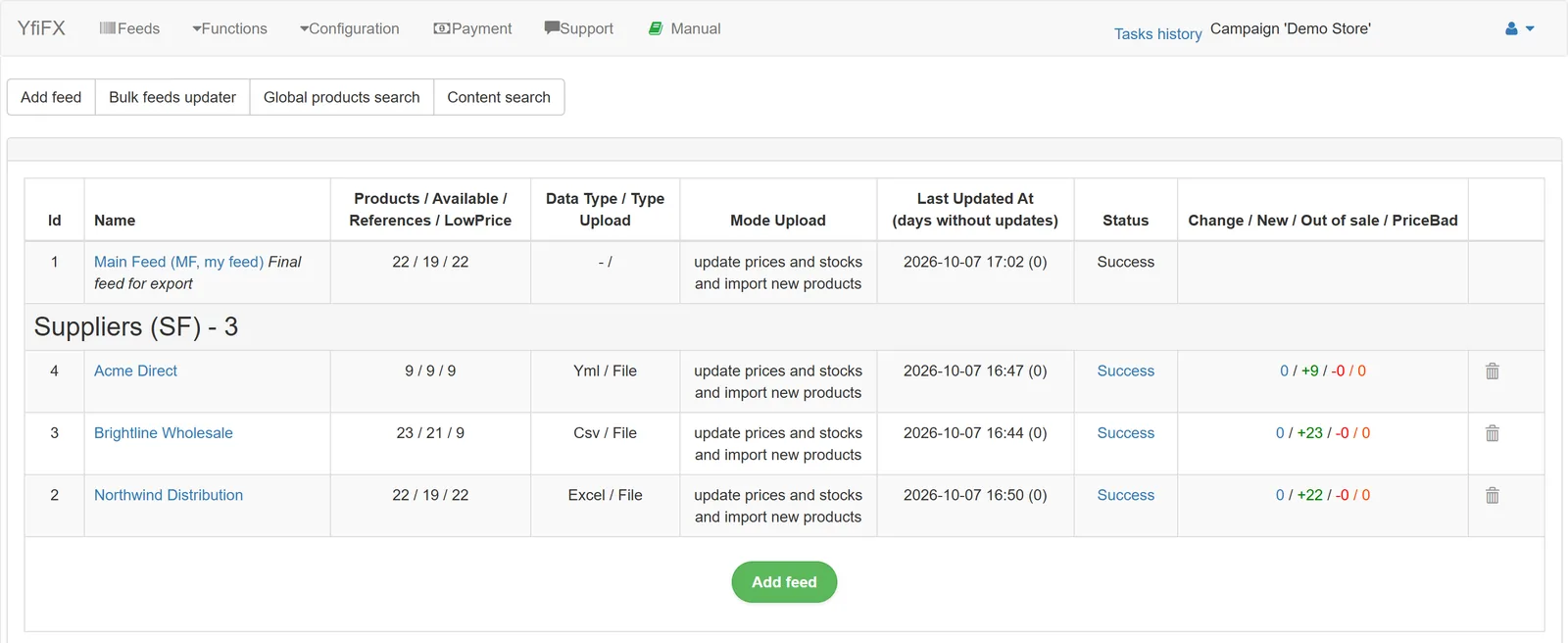
In YfiFX a supplier API is just another source for a supplier's price list, next to files, links, e-mail and FTP. You add the connection details, map the fields from the response (name, SKU, price, quantity, attributes) to the fields of your catalog, and the data arrives in the same format as any other price list.
From there everything works the same way regardless of the source:
- products are matched to your catalog by SKU or other fields;
- markup rules, currency conversion and supplier priority are applied;
- prices and stock are exported to your store, marketplace or product feed.
Scheduling the sync
Once the source is set up, add it to a schedule. Import, recalculation and export run as one chain at the times you choose, for example every morning before the store gets busy and again in the afternoon. The number of automatic runs per day depends on your plan.
Common problems and how to avoid them
Large catalogs often hit timeouts. Ask the supplier whether the API supports pagination or incremental updates, and avoid requesting the full catalog more often than you need it.
Field names change too, because suppliers update their APIs. Check the import log after each run, so a renamed field does not quietly set prices to zero. Store the supplier's currency explicitly and convert it at a defined rate instead of assuming it. And note down when the access token expires, so you can renew it before the import stops working.
When there is no API
Not every supplier has one. In that case a price list by link, e-mail or FTP gives you most of the benefits, and if a supplier only publishes prices on their website, YfiFX can collect prices, stock and content directly from the site with its scraper.
Related Articles
Set it up once. YfiFX does the rest
14 Days Free Trial. Sign up and import your first price list today.